
Global and Indian Workplace Wellbeing Statistics
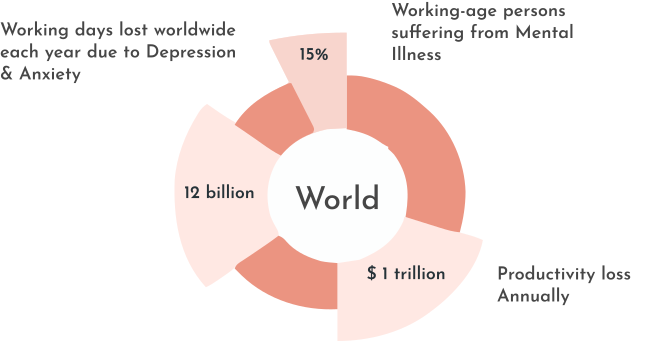
A safe and healthy workplace is a fundamental right. It reduces tension and conflict at work, boost employee retention, and increase performance and productivity. However, according to WHO estimations, unfavourable working conditions, such as discrimination, inequality, heavy workloads, ineffective workplace management, and job instability, can be dangerous to one's mental health. According to the estimates for 2019, 15% of working-age persons are suffering from some or other mental illnesses. An estimated 12 billion working days are lost worldwide each year due to depression and anxiety, costing US$ 1 trillion in lost productivity annually.
According to the WHO, government agencies, businesses, unions that represent both employees and employers, and other stakeholders can take steps to improve mental health at work by assisting those who are suffering from mental illnesses, preventing work-related mental illnesses, and fostering an environment that is conducive to change.
Source: WHO
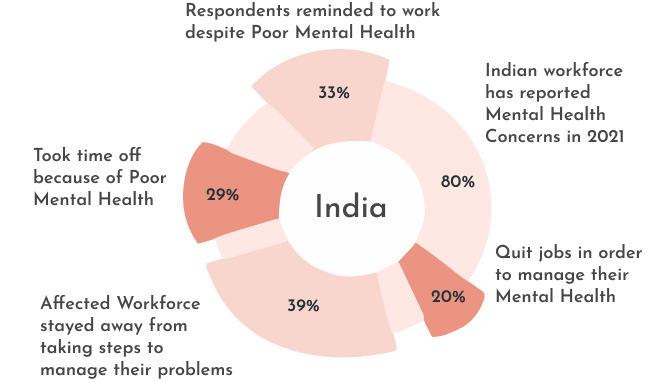
According to survey conducted by Deloitte Touche Tohmatsu India LLP (DTTILLP), 80% of Indian workforce has reported mental health concerns in 2021. Due to stigma related to mental health, 39% of affected workforce stayed away from taking effective steps to manage their problems. In addition, the survey revealed that 33% of respondents remained to work despite having poor mental health, while 29% took time off, and 20% quit in order to manage their mental health more effectively. ASSOCHAM's corporate employees' survey in 2015 revealed that 42.5% of the corporate employees in India are suffering from depression or general anxiety disorder.
Various reports also indicate that businesses must prioritise their employees' mental health and wellbeing, and it is crucial that top executives play a significant role in de-stigmatizing mental health issues inside their organisation. It was suggested that action should be taken to provide a setting where employees' wellbeing is valued and they have access to the assistance whenever they require in order for everyone to succeed.
Source: Deloitte | ASSOCHAM